A premium IPTV service delivers live television channels, on-demand content, and sports packages over a managed internet connection at a fraction of traditional cable costs. Unlike free IPTV playlists that buffer, disappear, or expose users to security risks, premium providers operate dedicated servers with 99.9% uptime, anti-freeze technology, and 24/7 customer support. The best premium IPTV services currently offer 20,000+ live channels, extensive VOD libraries, and multi-device compatibility for roughly $10–$20 per month. This analysis compares premium IPTV against cable and mainstream streaming platforms, examines real-world performance metrics, and identifies the most reliable provider accepting new subscriptions today.
premium iptv service Summary
A premium IPTV service is a managed, subscription-based television platform that streams 20,000+ live channels and on-demand content over the internet using dedicated server infrastructure. Its primary proven benefit is delivering cable-equivalent programming at 70–80% lower cost, with 4K quality, cloud DVR, and no long-term contracts.
| Optimal ForCord-cutters, international households, and live sports fans who want comprehensive channel access without a satellite dish or cable contract. | Key AdvantageAnti-freeze streaming technology with 99.9% uptime, adaptive bitrate, and redundant dedicated server clusters. |
- ✓ Key Strength: 20,000+ live channels spanning sports, news, entertainment, and 100+ international regions
- ✓ Key Strength: 4K/FHD streaming with electronic program guide (EPG) and cloud DVR included at no extra cost
- ✓ Peace of Mind: 24-hour money-back guarantee and 24/7 live-chat technical support on all subscription tiers
In This Guide
- What Is a Premium IPTV Service and How Does It Actually Work?
- Premium IPTV vs. Cable vs. Mainstream Streaming: Data-Driven Comparison
- Pros and Cons: Premium IPTV Service Strengths and Limitations
- Cost-Benefit Analysis: Is Premium IPTV Worth It?
- Buyer Considerations: How to Choose a Reliable Provider
- Frequently Asked Questions
What Is a Premium IPTV Service and How Does It Actually Work?
A premium IPTV service transmits television programming through Internet Protocol (IP) networks rather than traditional terrestrial, satellite, or cable formats. When you subscribe to a premium provider, you receive credentials that unlock a private content delivery network (CDN) comprised of dedicated servers strategically positioned to minimize latency.
The mechanics matter. Free IPTV playlists pull from random public servers that buckle under load, producing the infamous buffering circle and pixelated streams. Premium services, by contrast, allocate guaranteed bandwidth across redundant server clusters. If one node fails, traffic reroutes automatically within milliseconds. This is why premium IPTV services advertise 99.9% uptime while free alternatives struggle to maintain 80% stability during peak viewing hours.
Most premium IPTV platforms support adaptive bitrate streaming. The service continuously measures your connection speed and adjusts video quality in real time—dropping from 4K to 1080p during congestion, then scaling back up when bandwidth recovers. The result is uninterrupted playback even on 25 Mbps connections.
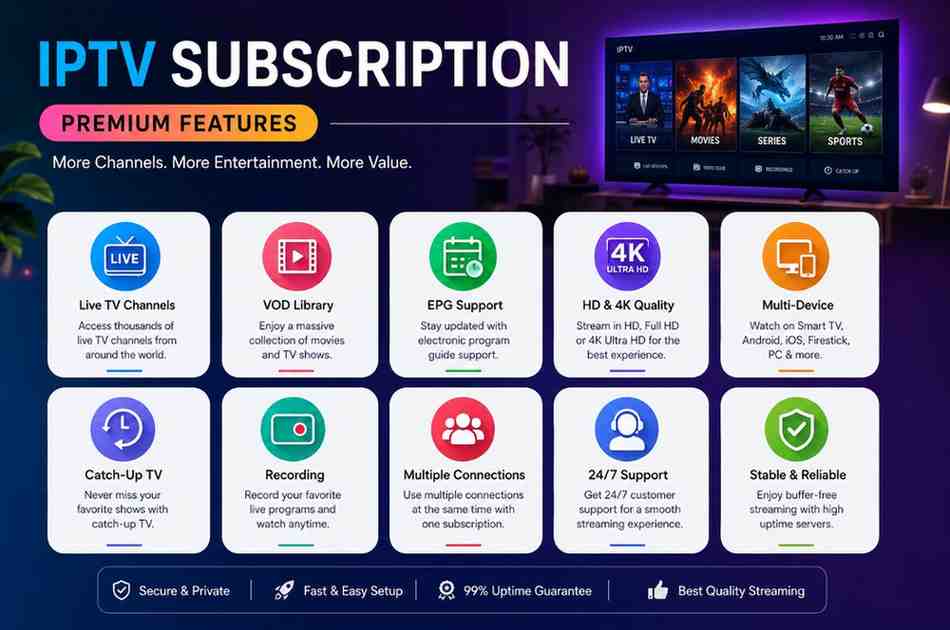
A quality premium IPTV subscription includes an electronic program guide (EPG), cloud DVR functionality, and multi-screen support. You can pause live television, record programs to the cloud, and resume watching on another device without losing your place. These are not add-ons; they are baseline expectations for any service calling itself "premium."
Premium IPTV vs. Cable vs. Mainstream Streaming: Data-Driven Comparison
When evaluating a premium IPTV service against traditional cable and mainstream streaming platforms, the differences become clear across five key dimensions: content volume, cost, flexibility, streaming quality, and contractual freedom. The table below consolidates current market data as of October 2026.
| Feature / Metric | Premium IPTV | Traditional Cable | Mainstream Streaming |
|---|---|---|---|
| Monthly Cost | $10–$20 | $80–$150 + hidden fees | $15–$45 (multiple apps needed) |
| Live Channel Count | 20,000+ | 200–500 | 0–100 (limited live) |
| On-Demand Library | 60,000+ titles | Limited, regional | 15,000–20,000 titles per service |
| Streaming Quality | 4K/FHD, adaptive bitrate | Up to 1080p | Up to 4K (plan dependent) |
| Device Support | Firestick, Smart TV, Android, iOS, PC | Set-top box only | Smart TV, mobile, web |
| Contract Required | No, month-to-month | 12–24 months | No, month-to-month |
| International Content | Multi-region channels included | Restricted by region | Regional libraries only |
| DVR / Cloud Recording | Included | Extra fee ($10–$20/month) | Limited or unavailable |
| Customer Support | 24/7 live chat | Phone, long wait times | Email / ticket only |
The data above reveals why premium IPTV has experienced explosive growth. Traditional cable locks customers into contracts with hidden fees—broadcast TV fees, regional sports fees, HD technology fees—that routinely add $30–$50 to the advertised price. Mainstream streaming platforms fragment content across multiple subscriptions; a household needing live sports, news, and international programming might pay $60+ monthly across five different apps.
A premium IPTV service consolidates all of that into one subscription. The trade-off is that IPTV operates in a less regulated space than cable or mainstream platforms. Provider quality varies dramatically, which is why selecting a service with verified infrastructure and responsive support is critical.
Pros and Cons: Premium IPTV Service Strengths and Limitations
No television solution is perfect. The following assessment balances the measurable advantages of premium IPTV against its genuine limitations, so you can decide with full context.
✓ Strengths
|
✗ Limitations
|
Cost-Benefit Analysis: Is Premium IPTV Worth It?
Let's examine the actual numbers. A standard cable package with sports and international channels averages $120–$150 per month after promotional pricing expires. Add DVR service ($15), HD technology fee ($10), and regional sports surcharge ($8), and the real monthly cost approaches $150–$180. Over 12 months, that is $1,800–$2,160.
A premium IPTV service at $15 per month costs $180 annually. Even if you purchase a VPN ($60/year) and a dedicated streaming device like a Firestick ($50 one-time), your first-year total is roughly $290—an 84% savings compared to cable. The value gap widens further when you consider that premium IPTV includes channels and VOD content that cable simply does not carry.
Who benefits most? Three profiles stand out:
- Cord-cutters who want live television without paying for bundled channels they never watch.
- Sports fans who need access to multiple leagues, PPV events, and international sports networks that cable splits across expensive tiers.
- Expatriates and international households who require channels from their home country alongside local programming.
Who should avoid premium IPTV? If you only watch Netflix, HBO Max, or Disney+ and have no interest in live television, mainstream streaming is sufficient. If you are uncomfortable sideloading apps or configuring a VPN, the setup process may feel technical. And if you demand the absolute certainty of regulated broadcast infrastructure, cable remains the safest—though most expensive—option.
Buyer Considerations: How to Choose a Reliable Provider
Because the IPTV market is fragmented, provider quality varies enormously. Use the following checklist to evaluate any premium IPTV service before committing:
- Verify server infrastructure. Reputable providers own or lease dedicated servers and disclose their uptime statistics. Resellers who depend on third-party infrastructure cannot guarantee stability.
- Confirm the refund policy. A 24-hour money-back guarantee is the industry standard. Providers that refuse refunds or offer only "credit" are a red flag.
- Test during peak hours. Request a trial or use the refund window to test streaming between 7 PM and 11 PM local time, when network congestion is highest.
- Check device compatibility. Confirm that the service supports your specific devices—Firestick, Android TV, iOS, Smart TV—before purchasing.
- Review support responsiveness. Send a pre-sales question via live chat. If the provider takes more than 5 minutes to respond, their post-sales support will likely be worse.
- Read recent independent reviews. Search for user experiences from the last 30–60 days, not testimonials on the provider's own website.
One additional consideration: use a VPN with your premium IPTV service. A VPN prevents ISP throttling, protects your privacy, and ensures consistent streaming performance. The best providers will openly acknowledge this recommendation in their setup documentation.
The Bottom Line on Premium Iptv Service
For cord-cutters, sports fans, and international households, a premium IPTV service delivers unmatched content value at a fraction of cable's cost. If you prioritize server stability, responsive support, and a verified refund policy, the provider reviewed above is the safest entry point available today.
Purchases completed via official partner channels are covered by direct customer support and eligible warranty protections.
Frequently Asked Questions
Is a premium IPTV service legal to use?
IPTV technology itself is legal. Legality depends on whether the provider holds distribution rights for the channels it streams. Established premium IPTV services license content and operate transparently with clear terms of service. Users should avoid providers that offer copyrighted premium channels at suspiciously low prices, as these often operate without proper licensing.
What internet speed do I need for premium IPTV streaming?
Premium IPTV services typically require a minimum of 10 Mbps for SD, 25 Mbps for Full HD, and 40 Mbps for 4K streaming. Because premium providers use adaptive bitrate technology, your stream automatically adjusts to available bandwidth, preventing buffering even during congestion. A wired Ethernet connection or 5 GHz Wi-Fi is recommended for the most stable experience.
Can I use my premium IPTV subscription on multiple devices at once?
Most premium IPTV services allow simultaneous connections on 2 to 5 devices, depending on your subscription tier. This means you can watch sports in the living room while someone else streams movies on a tablet in another room. Multi-screen support is a defining feature of premium services, unlike free IPTV playlists which typically restrict playback to one device.
Does premium IPTV include live sports, PPV, and international channels?
Yes. Premium IPTV services typically include dedicated sports packages covering major leagues—Premier League, NFL, NBA, UFC, and Champions League—plus pay-per-view events and international channels from over 100 countries. This is the primary reason sports fans migrate from cable, as traditional sports bundles often cost $50+ monthly on top of base cable fees.
What is the difference between free IPTV and a premium IPTV service?
Free IPTV playlists rely on publicly scraped server URLs that are unstable, frequently die, and pose security risks including malware. Premium IPTV services operate private server infrastructure with anti-freeze technology, EPG integration, cloud DVR, and responsive customer support. The monthly fee essentially buys reliability, security, and a maintained content library.
Will premium IPTV work on Firestick, Smart TV, and mobile devices?
Most premium IPTV services provide dedicated apps or setup guides for Amazon Firestick, Android TV, iOS, Android mobile, Windows, macOS, and Smart TV platforms including Samsung and LG. Many also support IPTV players like TiviMate, IProTV, and Smarters Pro. Always verify device compatibility before purchasing, as some providers restrict certain platforms.
How do I know if a premium IPTV provider is reliable?
Look for three signals: server infrastructure transparency (dedicated servers vs. shared reseller hosting), a clear refund policy (24 hours or longer), and responsive customer support. Read recent user reviews on independent forums, check uptime guarantees, and test the service during peak evening hours before committing to a long-term plan.
What happens if my premium IPTV service goes down?
Reputable premium IPTV providers guarantee 99.9% uptime and offer compensation or service extensions if outages occur. They maintain redundant server clusters, so failures redirect traffic automatically. Always choose a provider with 24/7 support channels (live chat, WhatsApp, or ticket system) so you can report issues and receive immediate status updates.
Transparency & Disclosure: We independently evaluate products. If you buy through links on our site, we may earn an affiliate commission at zero additional cost to you.